
Truth Bags
An uninterview with Caleb Jackson from Soup646

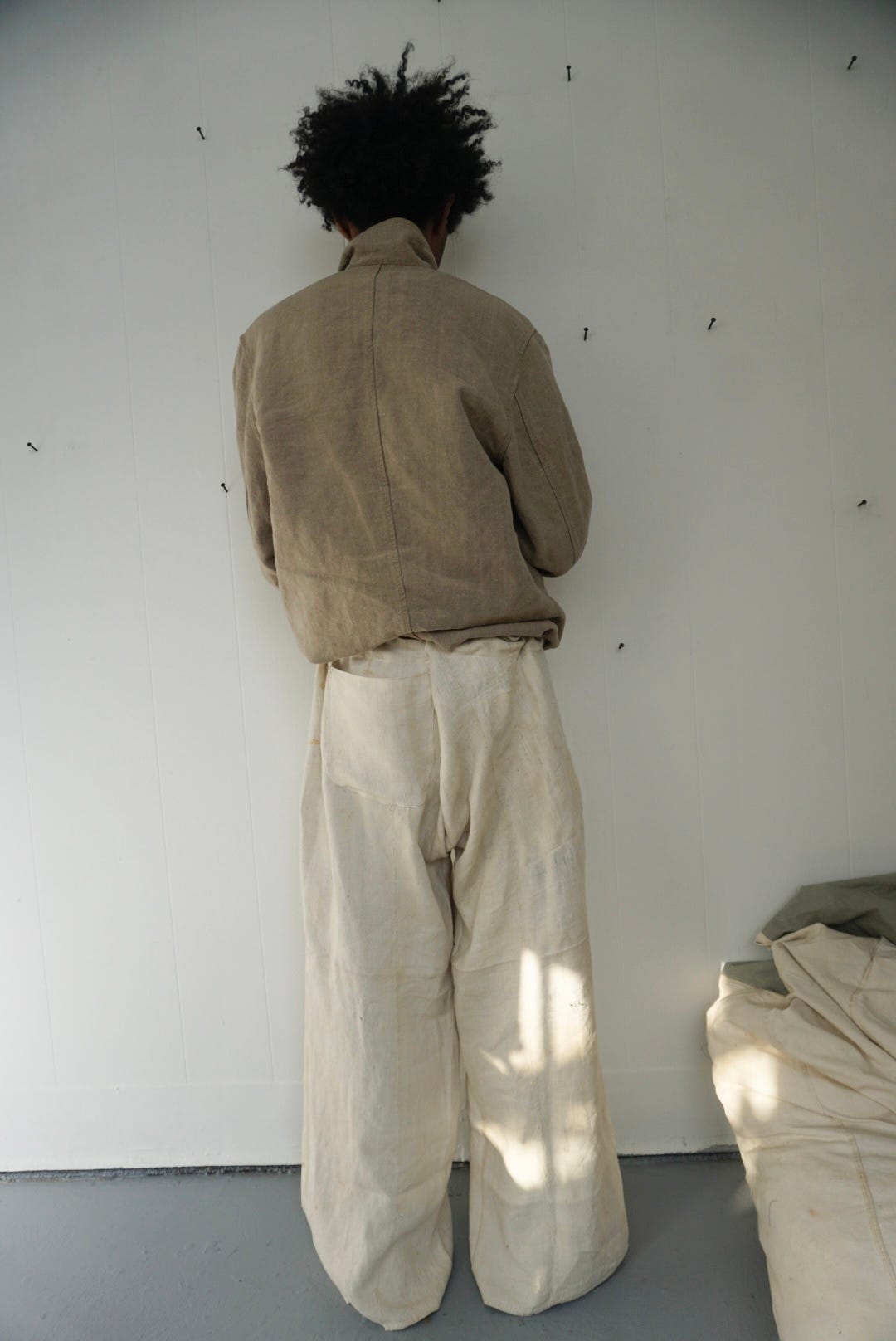
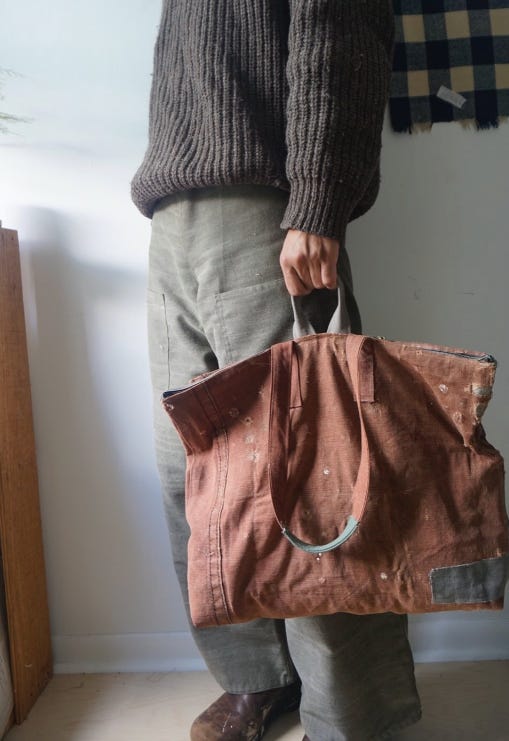
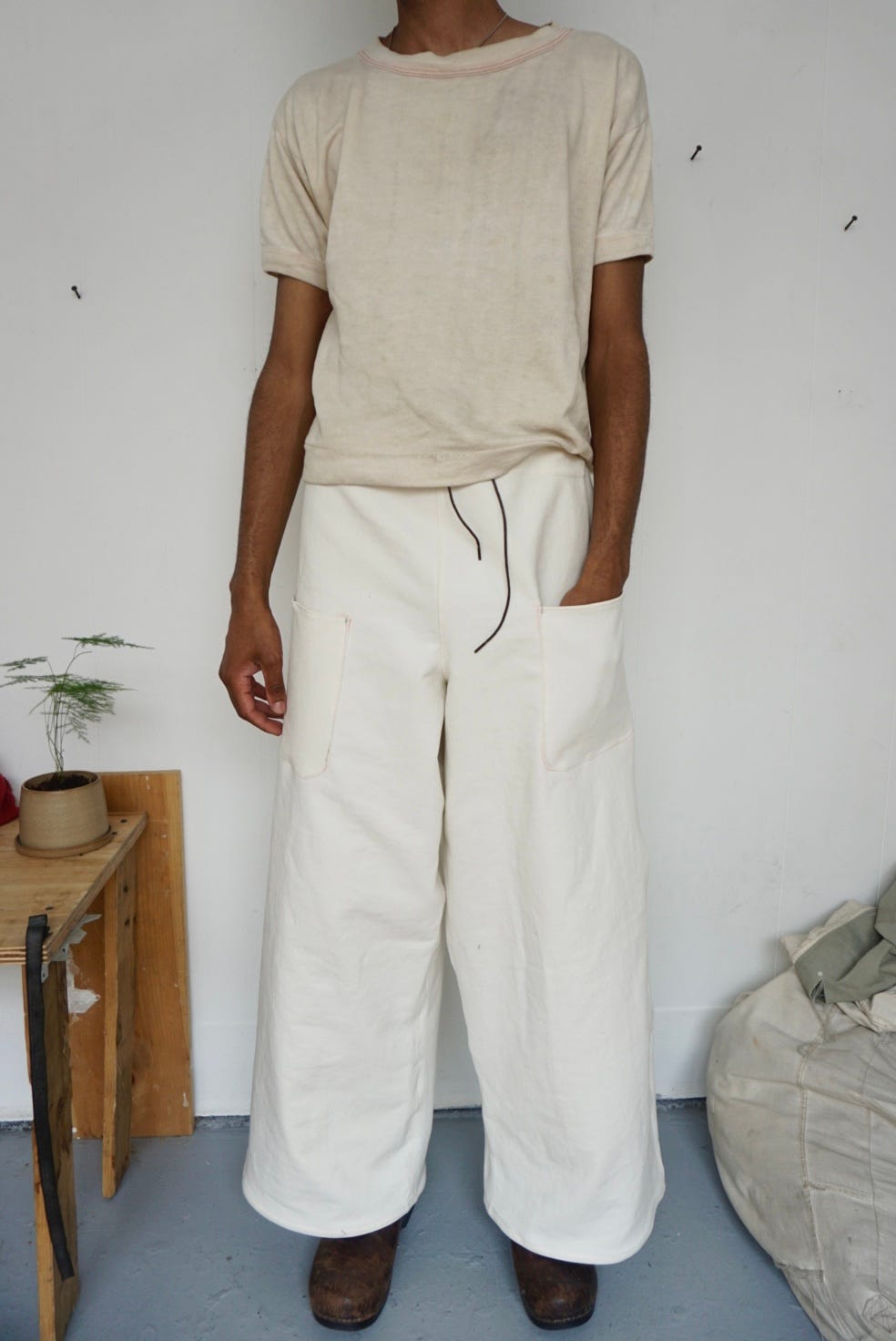
Based out of New York, Caleb Jackson — the young jazz trumpeter-turned-clothes-and-accessories-designer behind Soup646 — makes some of the best bags in existence. I mean, just look at it. This thing’s got aura.
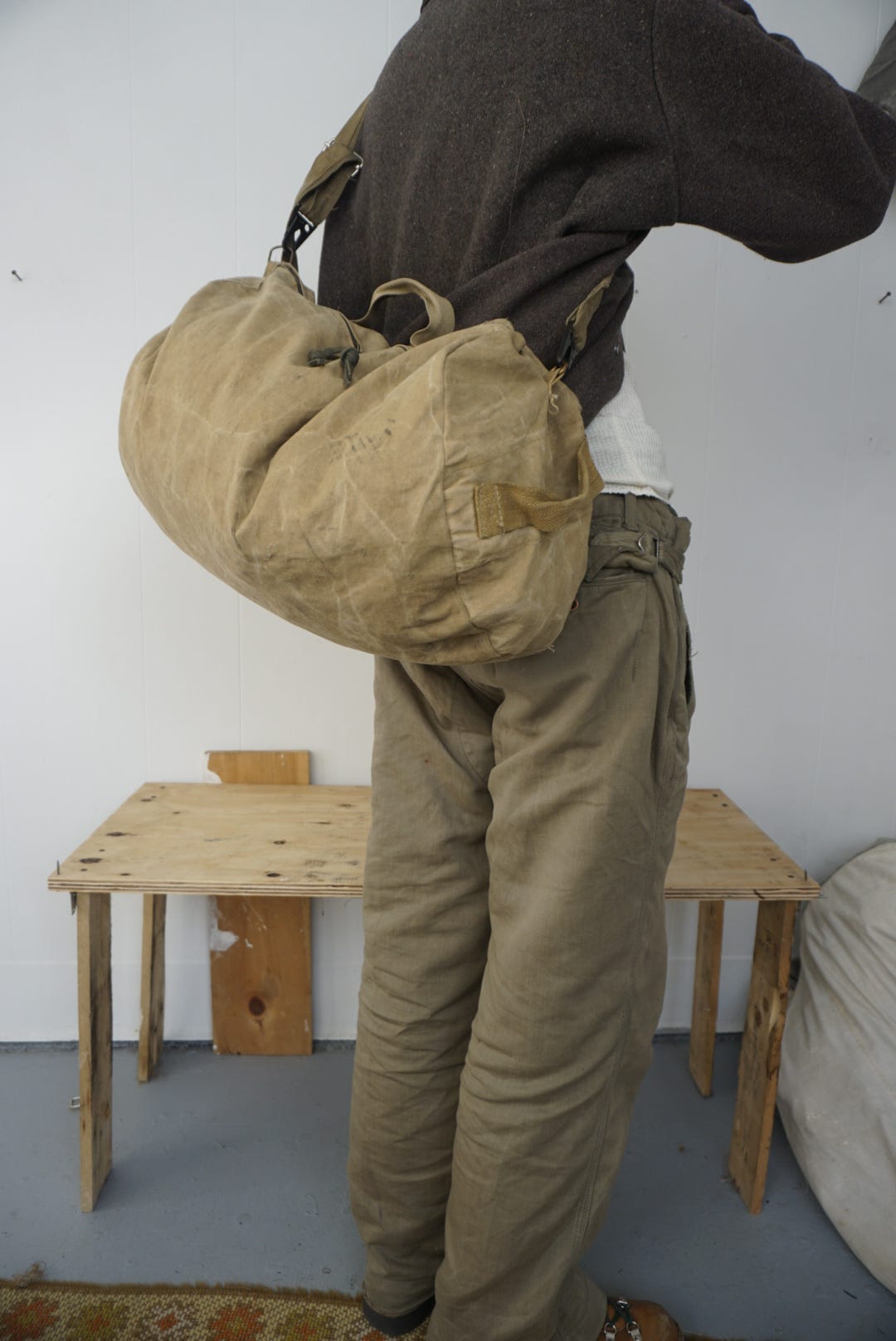
So, here’s what happened. I reached out to Caleb. We set a date for a video call. We had the video call. Caleb was wearing a loose knit sweater over a fleece quarter zip, speaking in sentences flowing like an improv solo. We talked for about an hour. I transcribed the whole conversation. And then, while reading the transcript, I realized we had spoken about bags for exactly two minutes.
This made me wonder: Don’t you need to talk about bags when talking to someone you reached out to because of their bags? Did something go wrong here? If so, who was to blame? If not, what was going on?
Before I knew it, I concluded everything and everyone was perfectly okay. Yes, I believe it would be nice for GQ-type interviews with designers to occasionally discuss what these designers actually do, rather than marvel at how above-average their lives are. But I’m not GQ — (un)fortunately? — and, in any case, I — like so many of us, I believe (I hope?!) — hold the positively odd opinion that you don’t need to talk to say something about what you’re talking about.
Perhaps that’s my own little counterpart to uninterviewable designers: uninterview the heck out of the designers you’re actually interviewing. Or maybe it’s just some sort of attempt to introduce non-duality into the fashion Substack-o-sphere. At the end of the day, if there’s no distinction between “this” and “that,” then when you’re talking about “that,” you’re also talking about “this.”
And what applies to literally everything and everyone, by definition, also applies to bags as well as to Caleb and me. So, what did(n’t) we talk about when we talked about Soup646? Let’s get to it. No wait, before you start reading, put on this playlist of songs Caleb and I exchanged — it’ll get you into the right state of mind.
Lukas Mauve: Caleb, if I’d ask you to introduce the brand, what would you say?
Caleb Jackson: “Man, I have a hard time calling it a brand. It started so innocently. It was just pure curiosity on my part. I wanted to create something because I was interested in doing it. But I only knew vaguely and intuitively what ‘doing it’ even meant.”
Lukas Mauve: What about yourself then — what would you say about yourself as the doer behind this doing?
Caleb Jackson: “It took form gradually during my time at The New School, studying jazz there. You know, jazz conservatories are notoriously regimented — it’s almost like going to bootcamp. The teachers are like these 70- to 75-year-old jazz legends who, back in the day, played with the most incredible, most innovative musicians — people who really, deeply changed culture. They were rebels, man. They had beautiful things to say and express.
“But some of these teachers, they had become the most stubborn, egotistical people I’ve met in my life. I went up there under the impression that I would be trying to create jazz like they had done when they were young. Oh, I was incredibly wrong. I had endless fights with my teachers.
“One of them I spent a lot of time with, and all he did was basically trying to shut down all my ideas — ‘It has no function, no reason — it’s nebulous. You can’t do any of this without first learning the fundamentals!’ And I agree, to an extent. But, you know, I was also like: ‘The people you played with and you admire, many of them just got on their horn and played something so pure — because it came from somewhere true.
“The whole experience drove me insane, and it made me hate the culture, really. It was just preserving a very specific time in history in a way that felt opposite to how that time was created. Doing something else was seen as stupid, dumb, and ignorant.”
Lukas Mauve: Do you think your fellow students felt the same?
Caleb Jackson: “That’s complex. I was surrounded by students, you know, I wouldn’t say privileged, but at least students with an abundance of resources. It was just crazy to me. They had the resources to platform their art, their music in ways unimaginable. It felt frustrating, of course.
“I really felt like that’s not what it’s about, that’s not what we’re here to do. We’re here to create something real — something true to the essence of the people we are individually, and collectively maybe. Also, I was very fortunate to have been able to attend because of a good scholarship. At the time, I was 18 and didn’t really know what else I was going to do. Like, I’m from a super regular working class American family. My dad’s an immigrant from Jamaica — and my mom is Italian from Ossining, New York. And there I was at this liberal arts school in New York City surrounded by kids whose parents are movie stars or own a billion-dollar company.”
“Let’s just say that during college I was feeling so outcasted and frustrated. As soon as I left I knew I had to do something that I felt my expression could shine through. I was like ‘screw this stuff, I’m gonna start something that’s totally true to who I am, and while doing it I’m not going to follow any fundamentals or rules or anything. This is how I see it and how I want to make it, and that’s it.”
Lukas Mauve: And that something is Soup646?
Caleb Jackson: “Yeah, it’s my way of following in the footsteps of these jazz musicians that I was completely in love with — like Sun Ra or Ornette Coleman or Coltrane in the later stages of his career. They really had to fight to say something, and man they did say it.”


Lukas: We’ll have to say more about that. But let me first check: you did graduate from The New School in the end?
Caleb Jackson: “Yeah, I did, in 2023.”
Lukas Mauve: How did that go?
Caleb Jackson: “By the end of my senior year, I remember having this really powerful experience. I was in an ensemble led by an incredible bass player, Gene Perlow. He plays on this amazing album called Night at the Lighthouse with Elvin Jones on drums. I don’t remember the exact song we were playing, but I played it in my own style. I made a few mistakes, sure, but I was really trying to experiment, to explore what I’d been working on. Mid-performance, he just stormed out of the room — he was so upset. After that, another legendary bass player, Reggie Workman — who’s played with both Coltranes, and countless others — said to me: ‘If your heart’s not in this, you should go sell car insurance.’ I was just stunned. It blew my mind. That felt like a tipping point for me.”
“But I will say, there was one teacher — his name is Darius Jones, he’s still playing music, a very out-there guy, in an incredible way, in the best way — and he was like, ‘I see what you’re up to.’ That was so important to me.”
Lukas Mauve: Okay, so — it’s 2023 now, post-graduation. What did your life look like then?
Caleb Jackson: “Well, I graduated and I felt exhausted. On the last day, I had one more talk with one of my professors, telling me that I had wasted my time there. He was right, I guess — and he was well-intentioned. My time there was, in fact, pointless. At the same time, there’s no doubt it gave me something to rebel against — which in turn has been absolutely crucial for realizing my intuitions.
“So, after I left college, I was doing a coffee shop gig and really just thinking over what I wanted to do. A needed break from the trumpet. Every time I was playing I was reminded of these people, these ideas, these experiences. I still love it, I do. But with the bags and the clothes I know I’m going to do it, I’m already doing it, exactly how I want to do it — free from whatever. It’s not something I need to really convince the world of. I just do it because I enjoy it — I genuinely enjoy it.”
Lukas Mauve: You make it seem as if you were able to make bags and clothes out of nowhere. Surely, you must have developed some skills, right?
Caleb Jackson: “Yeah, well — I would say the way I learned was like, you know my mom got me this standard, domestic sewing machine when I turned 19. Shortly after that I started going to flea markets in the city to find fabrics or jackets or whatever that interested me. I guess that just piqued my interest, somehow. I would cut those up and make rudimentary, like very unskillfully put together, little sacks — I wouldn’t even call them bags. It kind of just grew from there.
“During college, my interest didn’t really die out. I just kept trying to find new ways. I never really watched any tutorials or anything explaining how I should do it. I just went for it. I did have a friend who knew this stuff and he showed me how to thread the sewing machine — which at the time felt really crazy and difficult, but it’s extremely easy, really.
“Back then it was just a fun little thing I was doing. There wasn’t much thought in it. It was just an expression that I enjoyed, also because it had function. Soup646 grew from there. I slowly learned to put things together more efficiently, and I learned new techniques. My friend and I would bounce ideas off of each other. And then by the time I graduated I got an industrial sewing machine. That was a necessary step for producing at volume and handle the fabrics I was interested in.”
Lukas Mauve: Do you feel that there is (or was) any positive relation between playing the trumpet and making the bags — apart from the last offering an alternative to your bad experiences with the first?
Caleb Jackson: “Totally. Both are about the feelings I’m having and the feelings I want to express, and the things I’m trying to see and manifest in the world that I don’t think are there yet. For me, in the beginning, it was really abstract in a way, it was just about the freedom of throwing stuff together in a more or less intentional way. It’s was just pure experimentation, really. But experimentation that, in the end, led to something functional, you know what I mean?”


Lukas Mauve: I write a lot about clothes and listen to a lot of music. One thing I’m always struggling with is that music can hit you in a way — emotionally, I mean — that clothes can’t. Do you recognize that, as someone who’s channeling both registers? Does handling old deadstock fabric in any way have the same, raw intensity of playing the trumpet?
Caleb Jackson: “You know, for every craft it takes a lifetime to really get to that point where you can create something that might change your own or someone else’s life — that lifts you up to this place you didn’t think was even possible. I do feel I’m doing that now — to some extent, yeah, definitely.
“It has to do with the fabric, the texture, the history of where it came from, the extent to which you can allow distressing or repairs — to just see all that, and let it shine through. I really think that can create a lot of feeling. Put it this way. A painting can be really cool and powerful and it can deeply move me. That said, it doesn’t carry the same strength as a piece of clothing I would spend years using, and continuously look at, and of which I know: ‘wow, this person 50 or 60 years ago drew this weird thing here, and repaired this whole section’.
“It’s such an intuitive process. It’s not scientific. I do this, because it feels exactly right. I hope someone else, when they have this piece, will spend years and years inspecting it. That’s what I do, at any rate. I hang old textiles on my wall — they carry this energy, perhaps not as strong as a song or music, but still, you can really feel their presence, their influence on a room.”
Lukas Mauve: Do you listen to music when you’re making something?
Caleb Jackson: “Oh yeah, constantly. Like, music is channeled, you know, through my mind, through my heart, through my hands, into this material. I listen to these older musicians because to me they, in a way, represent the history of being true — the history of being honest and just trying to be your greatest good — dedicating your life to some expression. I really feel that’s the most beautiful thing we can do as humans: to just let it go and see it through to death.”
Lukas Mauve: And how do you see Soup646 developing, creatively speaking, or as a resource for expression in your own life?
Caleb Jackson: “Let’s just say it’s becoming more serious. At the moment it’s more and more about resources and time — about finding out how I make it work, how to manage production, what’s a reasonable amount of wholesale orders and how to balance them against my own ideas about what I want to create.
“It’s becoming a two-person thing now. I’m working together with Aliya Hidirlar, who’s based in Brooklyn. She has a fashion background, studying fashion design at Parsons. She’s really technically skilled and really knows what she’s doing — it’s awesome.”
Lukas Mauve: What does an average day look like for you?
Caleb Jackson: “I wake up, have a cup of tea, maybe read something, listen to music, and just pick something off of the to-do list — either create product to shoot, get back to people (which I’m really bad at, sorry, I apologize), look at stores I’d want to work with, and you know, or just spend some time dreaming. What do I want to work towards? What do I want to do next?”
Lukas Mauve: And what about the sourcing, then?
Caleb Jackson: “I love that. After graduating, I was obsessed — I just wanted to get into as many stores and markets as possible. I’ve this friend who does antique sourcing for a living. She goes through barns, abandoned houses, etcetera, in the Michigan area and on the East Coast as well. By now, she knows what I’m looking for.
“I go to flea markets and also buy from surplus warehouses throughout the United States that happen to sell really nice fabrics — it’s a risky business, a lot happens by chance because their website doesn’t really describe the fabrics. But they’re often incredible, like 50s or 60s deadstock duck canvases, or Swedish military canvases, like these super heavy, worn-out fabrics.
“There’s also this warehouse in Manhattan. It’s just like for stories of industrial packed with rolls and rolls of incredible stuff that. You know, I do want to be able to create products that can be reproduced, and not have to think twice about — like 20 pairs of the same pants and not just like one or two bags.”
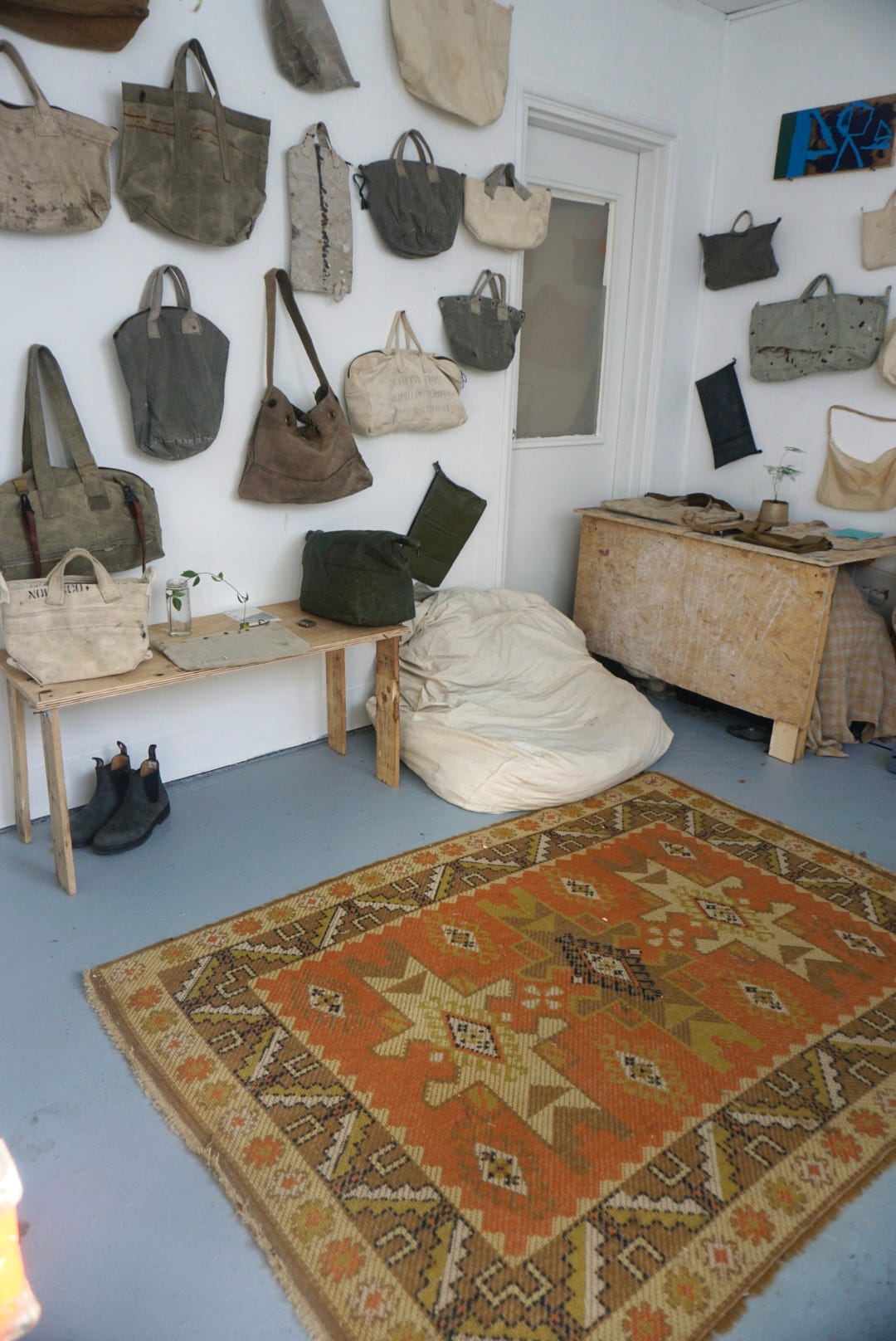
Lukas Mauve: Where are you sitting now, by the way?
Caleb Jackson: “I’m in my apartment, and I also work from here. I moved from Brooklyn three or four months ago. It’s a bit quieter here. If I’d stayed there, I was going to be unwell, for sure. It’s such an incredibly overstimulated place. It’s mostly concrete. It’s really tough. You’ve got all the highs and lows of all aspects of life happening all at the same time right before you own eyes. I needed a breather.”
Lukas Mauve: By the way, you’ve got to tell me how your bags ended up at Nho in Amsterdam, of all places. I only found out about that after I’d discovered your work!
Caleb Jackson: “Well, basically, I just approached them. It came to me one that — I’d seen them a couple of times, and I really enjoyed their presentation. I don’t know, it just spoke to me. And they’ve got a really large audience as well. They sell mostly vintage items, but I figured my items could be sold as such, in a way. So, I approached them, and I was like ‘can we create a product that resembles the vintage styles that you guys sell?’. They got on board right away.”
“It’s been the biggest thing I’ve taken on so far, in terms of workload. It was huge. For three or four months it was 80 percent of what I was doing, like, day to night.”
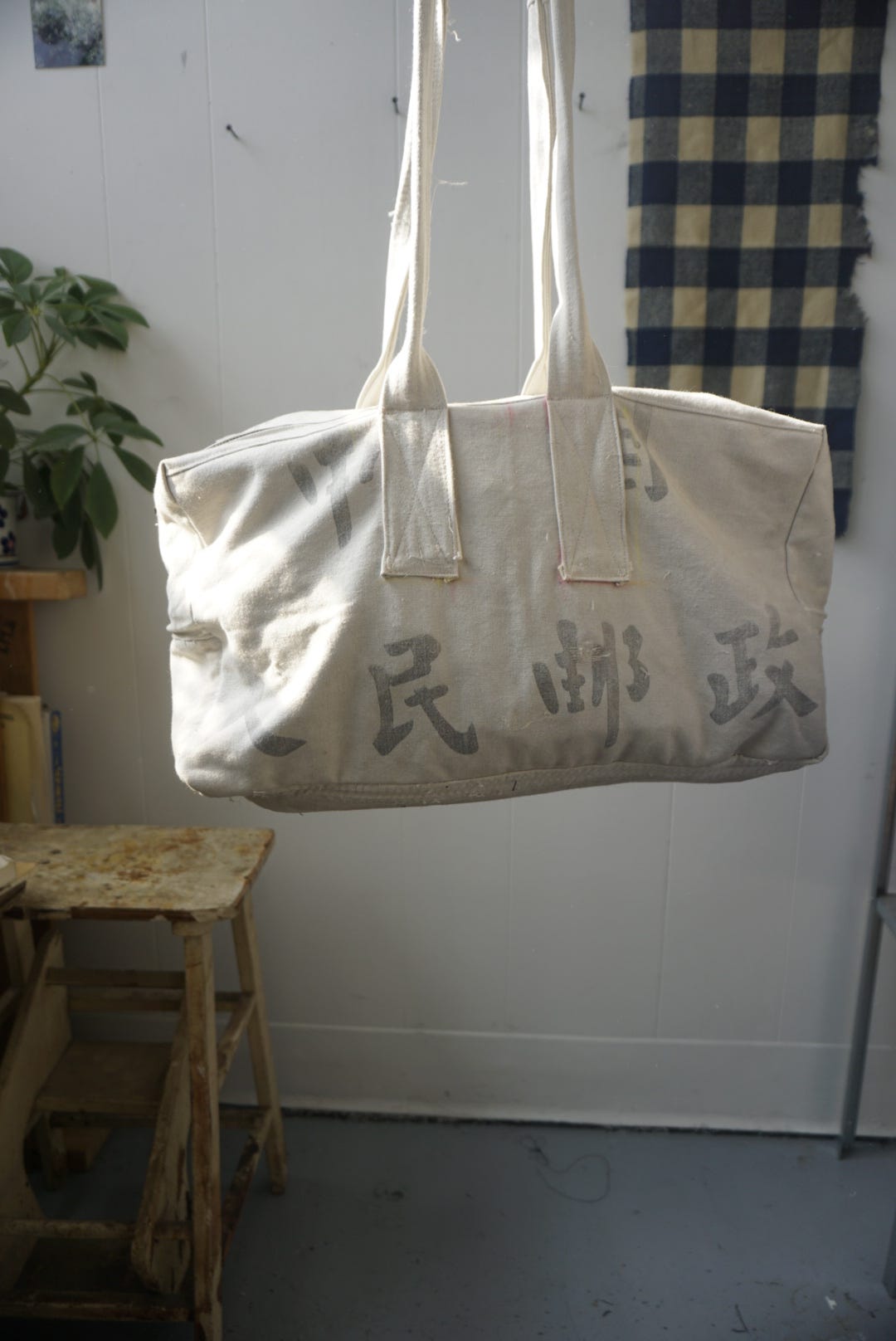
Lukas Mauve: What was your pitch? I mean, I feel your bags are special, but I’m having a hard time explaining why — at least without using vague words that don’t do any justice to their material reality, their physical presence. How did you do that?
Caleb Jackson: “Honestly, I barely describe anything. I just kind of throw out ideas. Okay, well, I do say like: ‘I make pieces from vintage textiles from the 50s and 60s, let’s collaborate’. It’s pretty simple.”
Lukas Mauve: You don’t say anything about the brand?
Caleb Jackson: “It’s not about the brand. It’s not about the bags or the clothes either. It’s just that, hopefully, one day, this thing I’m doing will encompass everything that I really enjoy making — like a lifestyle ecosystem, you know, with music, visuals, fabrics. I won’t say it’s my own version of Ralph Lauren. But I do want to create, to manifest something that reads exactly as how I hope to exist in this world. To me, each day, each week is a step in that direction.”
Lukas Mauve: We didn’t really talk about the bags, did we?
Caleb Jackson: “Yeah, I apologize if this wasn’t the intended outcome.
Lukas Mauve: No, no — not at all. I never really have an intentional outcome. Every interview is driven wherever the interview itself is going, as if it’s some sort of living thing.
Caleb Jackson: “Same here, same here. It feels real. I think it’s the kind of output this world needs. It’s a beautiful thing.”
Lukas Mauve: And what about the trumpet, by the way?
Caleb Jackson: “Man, I haven’t touched it since graduation!”
Thanks for reading. Don’t forget to subscribe to keep PF going — or upgrade to keep it going even more!
This is such a great interview. Thank you !
caleb + aliya = truth 🕊️🕊️